


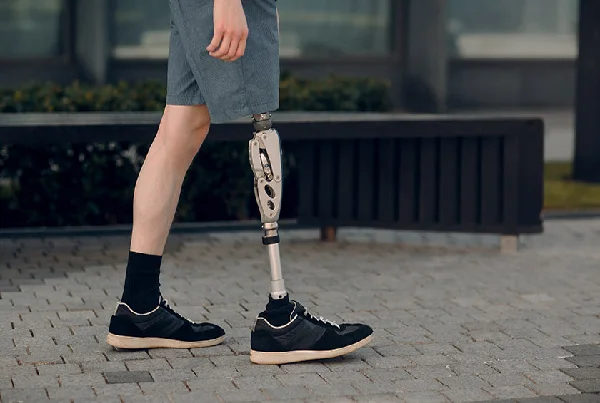
| Category | Lower Limb |
Lower limb prostheses are artificial devices designed to replace or augment the function of a missing or amputated leg. These prosthetic limbs aim to restore mobility, stability, and balance for individuals who have experienced lower limb amputation. Here are key aspects of lower limb prostheses:
Below-Knee (Transtibial) Prostheses: Designed for individuals who have undergone amputation below the knee joint.
Above-Knee (Transfemoral) Prostheses: Designed for individuals who have undergone amputation above the knee joint.
Symes Prostheses: A less common type, involving amputation through the ankle joint (Symes amputation).
Partial Foot Prostheses: Designed for those who have partial foot amputations.
Components:
Socket: The part of the prosthesis that fits onto the residual limb. It is custom-made to provide a comfortable and secure fit.
Pylon: A rigid rod or tube that connects the socket to the foot or ankle component.
Foot or Ankle Component: Mimics the function of the natural foot and provides stability during walking.
Knee Joint (for above-knee prostheses): For transfemoral amputees, an artificial knee joint is included to enable a more natural gait.
Prosthetic Knee Types (for above-knee prostheses):
Single-Axis Knee Joint: Allows movement in one plane and is generally stable.
Polycentric (Four-Bar) Knee Joint: Mimics the motion of the natural knee more closely, providing stability and a smoother gait.
Microprocessor-Controlled Knee (MPK): Advanced prosthetic knees with sensors and a microprocessor that adjust joint resistance and control during walking, providing a more natural and adaptive gait.
Suspension Systems:
Various methods are used to secure the prosthesis to the residual limb, such as suction, straps, or locking mechanisms.
Advancements in Technology:
Ongoing developments in materials, robotics, and sensors contribute to improved lower limb prosthetic design, including enhanced durability, comfort, and functionality.
Customization and Fit:
Each lower limb prosthesis is custom-designed to match the individual's specific amputation level, anatomy, and functional needs. Proper fitting and alignment are crucial for optimal performance.
Training and Rehabilitation:
Users undergo training and rehabilitation to adapt to the use of a lower limb prosthesis. This includes learning to walk, maintain balance, and navigate various terrains.


