BERA Hearing Test
| Category |
Audiology Services |
BERA, or Brainstem Evoked Response Audiometry, is a diagnostic test used to assess the auditory pathway and the brainstem's response to auditory stimuli. This test is also known as Auditory Brainstem Response (ABR) or Brainstem Auditory Evoked Potentials (BAEP). BERA measures the electrical activity generated by the auditory nerve and brainstem in response to sound stimuli, providing valuable information about the integrity of the auditory system.
Here is an overview of how a BERA hearing test is typically conducted:
-
Preparation:
- The individual undergoing the test is usually lying down or reclining in a comfortable position.
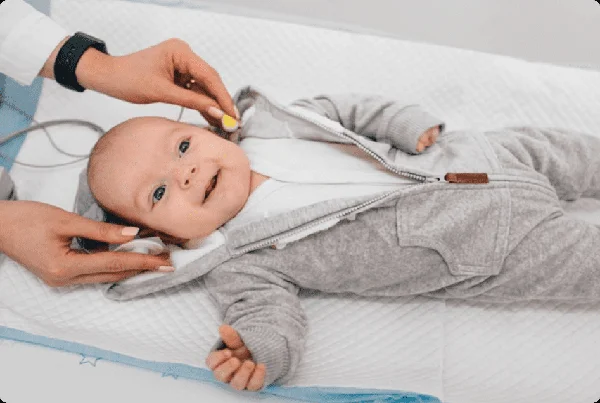
- Electrodes are attached to specific points on the scalp, typically on the forehead and behind the ears.
-
Stimulus Presentation:
- Earphones are placed in the ears, and the individual is exposed to a series of clicks or tone bursts at different frequencies and intensities.
- The stimuli are presented at a level that is audible but not uncomfortable.
-
Electrode Recording:
- Small surface electrodes are used to pick up the electrical responses generated by the auditory nerve and brainstem.
- These electrodes are connected to a computer or recording equipment.
-
Recording and Analysis:
- As the individual hears the stimuli, the electrodes record the electrical activity generated in response to each stimulus.
- The recorded responses are analyzed to determine the timing and amplitude of various waves, each representing a specific stage in the auditory pathway.
-
Waveforms:
- The BERA test typically yields several waves labeled I, II, III, IV, and V. Each wave corresponds to a different part of the auditory pathway, with Wave V representing the brainstem's response.
-
Interpretation:
- The audiologist or healthcare professional interprets the waveform patterns and latencies to assess the integrity of the auditory pathway.
- Abnormalities in the BERA results can help identify issues such as hearing loss, auditory nerve disorders, or brainstem abnormalities.
-
Clinical Applications:
- BERA is often used in newborn hearing screening programs to detect hearing issues early in infancy.
- It is also employed in diagnostic evaluations for individuals with suspected hearing disorders, especially when behavioral audiometry may be challenging, such as in infants or individuals with developmental or cognitive impairments.
The BERA hearing test is a valuable tool for assessing the auditory system, especially in cases where conventional audiometry may be difficult to perform. It provides objective information about the functioning of the auditory nerve and brainstem, aiding in the diagnosis and management of various auditory disorders.